
Eight Scudetti, four Italian Cups, and two French championships: it’s unlikely anyone will ever eclipse the achievements of Rose Reilly.
When Rose Reilly wandered away from her home in Stewarton, her three-year-old legs trudged 300 yards to the main road, right across from a big dusty patch of ground.
“My mum told me I disappeared around the corner, and she found me at the football pitch. I then wanted a ball with all my passion, but got a doll at Christmas, and in those days that was the only time you got something. I was so devastated I went out and swapped it for a ball. From the age of four, that ball went everywhere with me. I slept with it. If I went down the street for messages for my mum, I played keepie uppie on the way there, and on the way back. Sometimes there would be a wee hill or stairs, but on I went.”
On, and on – in a sporting journey that can be measured in the height of Rose’s triumphs, and in the miles travelled to achieve that success. She went from keepie uppie to a full-time professional career in women’s football, from the dark blue of a Scotland strip to the azzurro of Italy, scoring for them as they won the World Cup.
Rose, 62, has had her legendary status acknowledged in recent years, with induction into the Scottish Football Hall of Fame, the Scottish Sports Hall of Fame, and an honorary doctorate from the University of the West of Scotland. Yet as a young player, along with her friend Edna Neillis, who died two years ago, she was banned sine die from representing Scotland as she pursued a professional career overseas.
As Scotland’s women prepare for their first-ever major finals in this summer’s European Championships in the Netherlands, it’s intriguing to reflect that more than 40 years ago this country had already exported such playing talent to continental leagues.
The desire, the hunger, not just to play, but to play the best was what drove Rose at a time when girls and women footballers across Scotland faced prejudice and discrimination. Even after a 50-year ban stopping women from playing on the grounds of FA-affiliated clubs was lifted in England in 1971, it took another three years for the SFA to follow.
The young Rose Reilly, meanwhile, had long displayed the determination, and single-mindedness that would take her beyond any restrictive rules or attitudes to thrive at the highest level.
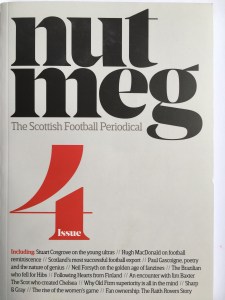
First published in Nutmeg 4. Read the full story here
 Ginny Clark
You must be logged in to post a comment.