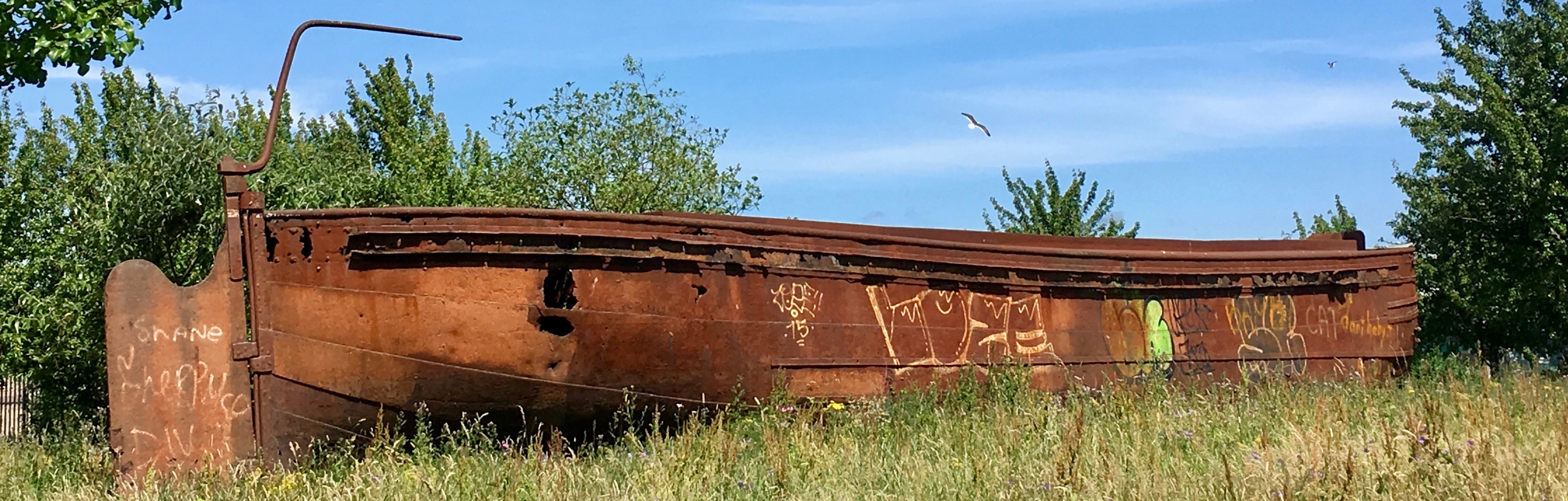
The old boat lists, wrecked upon thistle, lashed by a sea of yellow and purple. Here, in this quiet Glasgow corner, up Houston’s Brae and around Mid Wharf Street to an oasis between the basins of Port Dundas at the Forth and Clyde Canal, an abandoned ship is run aground.
The M8 may sweep around the bottom of the Brae, but on this summer’s day, noise fades against the hum of insects that hover and dip among buttercups and bindweed.
This area is no longer crammed with works and warehouses, the clamour and thrum of cargoes loaded and unloaded echoing around these streets. Now the canal wharves bubble with new sounds. In one basin, someone in a wetsuit wobbles on a board, swishes left and right at the end of a cable. In the other basin, whitewater churns as mechanised waves splash a challenge for kayakers and canoeists.
Between them, the rusting vessel, dredged from canal silt in 1993, is anchored in a grassy harbour. ‘The Cat’ is just one of the tags sprayed large across the battered hull that has become a den, a meeting place, a shelter, a party space. A sanctuary.
Yet there is little of the feline about this bulk. Not built for speed nor stealth, this old scow was a workhorse, an 1800s long-distance lorry, hauling coal and ironstone from the Lanarkshire pits through the Monkland Canal, into this Port Dundas junction to emerge upon the Forth and Clyde. Coaxed by two boat crew and another for the horse that towed and navigated through bends and locks, 60 feet of iron would heft up to 80 tons of cargo.
Fuel to grow Glasgow. For almost 200 years, Scottish colliers were contract-bound to masters, whole families, boy and man, girl and woman. Rock hewn in bloody sweat and borne in back-breaking basket-loads. Children working from coal face to pit mouth. Like the salt miners, traded and transferred with pits and lands, listed and numbered along with picks and buckets.
Dragged back from other masters if they moved on when a pit fell idle, miners faced imprisonment. The Colliers and Salters (Scotland) Act of 1775 began the change, Lanarkshire workers fighting for the amendment in 1799 that decreed the people of the pits “shall be deemed free”. In 1842 the new Act set out that women, girls and boys under 10 could no longer work underground, extending that 18 years later to all boys under 12.
Glasgow belched on, blackened amid the smog. Crowded canals could not keep pace with the railways, and soon steam drove traffic along the water. For horse-towed scows, time was running out. From the end of the 1850s, the canals too were in decline. The Monkland Canal closed in 1942, the Forth and Clyde maintaining navigation until it too closed in 1963. Forgotten, tangled dumping grounds, canal beds were the final destination for damaged and scuppered wrecks.
This scow was one of three recovered by the Forth and Clyde Canal Society as the waterway was reclaimed and reopened just after 2000. The others could not be saved. This scow sails on.
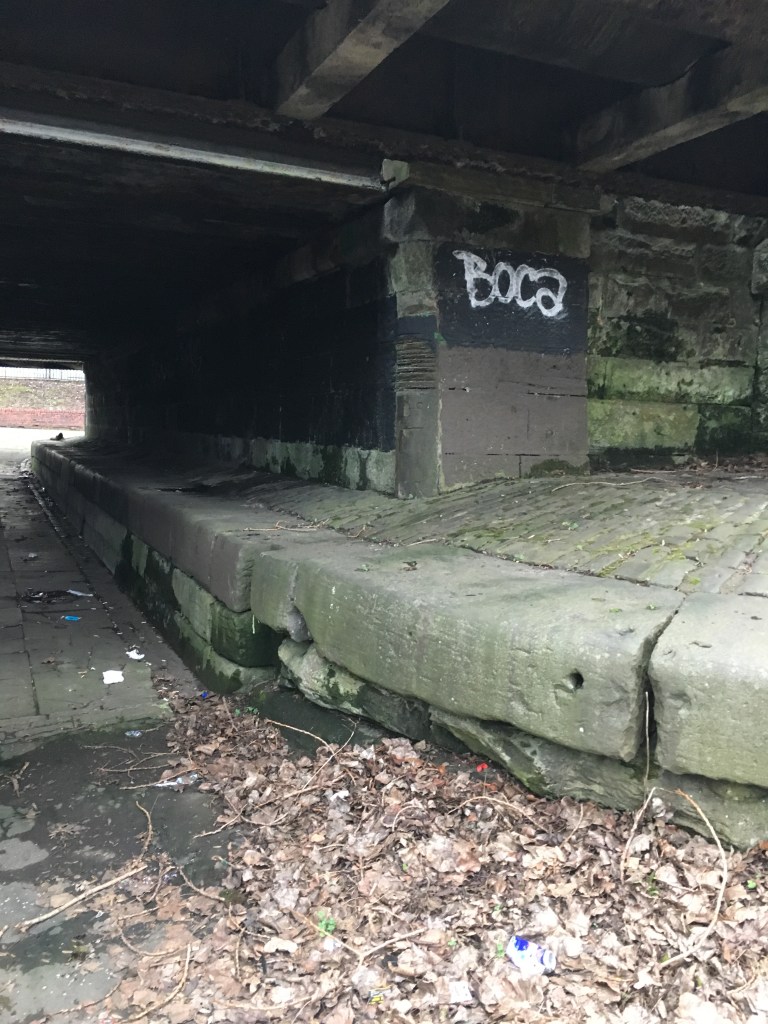
underneath the old bridge at Castle Street
A little piece of the old Monkland Canal still remains, beneath a road close to the M8. The towpath on one side of the filled-in channel and the walls that line it … You can still see marks worn into the stone where boat crews and horses braced the tow rope to guide vessels through.
pic Ginny Clark
There are no docks aside the Dundas basins now. No foundry, glassworks or distillery along the canal stretch beyond. Not bounded by a soap factory or a granary or a timber yard. The streets here on the south and the north banks are now home to offices and small workshops.
The scow is a monument, shaped by the embers of a city’s story. In glorious decay, it still floats upon this landscape, steering passage through the years.
Reminding us how we got here.
 Ginny Clark
You must be logged in to post a comment.