
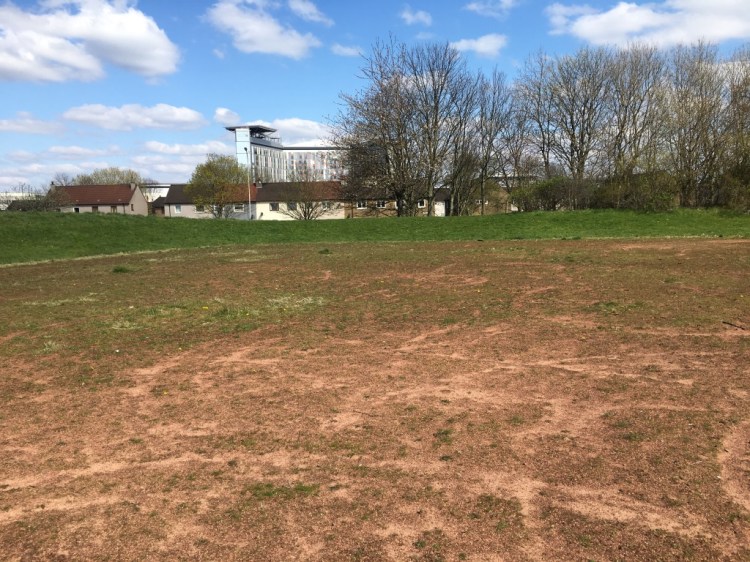
Glasgow’s fabled 50 Pitches playing fields may have been consumed by a motorway and business park, but their outline and legacy can still be traced …
The lush green turf of McKenna Park, home of Govan club St Anthony’s, a West of Scotland League side that has been part of the Glasgow football scene since 1902, hides a secret.
Ants secretary Felix McKenna walks me through their ground, past that pristine surface to the sturdy fence at the back that marks the club’s perimeter. Here there is a gate. Felix produces a key and the gate is creaked open so we can step through, to find ourselves on what appears to be a mix of wasteland and partially cultivated grass areas that stretch 100 yards or so away from us to a pathway boundary along the edge of the M8.
This path curves round to public entrances at each end, below McKenna Park on Fulbar Drive, and beyond it on Shieldhall Road. This is Drumoyne, on the western edge of Govan, and the existence of this space, an occasional route for runners or dog-walkers known as Cardonald Park, is not in itself a secret. The secret is what lies beneath.
I look a little closer at the two large flat areas. There are double sets of depressions at both ends of one, pot-holes sprouting wild flowers and tangled growth. A modern-made grassy slope rolls down on to one corner of the other. Yet red earth can be glimpsed through patches of grass and clumps of shrubs across these areas. An aerial view, courtesy of Google, provides further clarity. Not wasteland at all, but perhaps the last two remaining of the 50 Pitches?
First published in Nutmeg 21. You can read the full story here
 Ginny Clark
You must be logged in to post a comment.